
Economics
Kiwi Dollar Weakens as New Zealand Jobless Rate Hits Highest Level Since 2015
New Zealand's unemployment rate rose to 5.6% in the June quarter, surpassing expectations and indicating a growing slack in the labor market. This development complicates the Reserve Bank of New Zealand's (RBNZ) monetary policy decisions, with markets pricing in a high likelihood of a rate hike at the upcoming meeting.
RBNZ Faces Dilemma Ahead of September Meeting Amid Rising Unemployment and Wage Stagnation
Entities & knowledge links
Executive summary
New Zealand's unemployment rate rose to 5.6% in the June quarter, surpassing expectations and indicating a growing slack in the labor market. This development complicates the Reserve Bank of New Zealand's (RBNZ) monetary policy decisions, with markets pricing in a high likelihood of a rate hike at the upcoming meeting.
New Zealand's unemployment rate climbed to 5.6% in the June quarter, the highest since late 2015, as more individuals entered the workforce than the economy could absorb. This increase in joblessness, coupled with subdued wage growth, suggests that the RBNZ may adopt a cautious approach to further interest rate hikes. The underutilisation rate, which includes those unemployed and those seeking more hours, rose to 13.8%, indicating broader labor market slack than the headline unemployment figure suggests.
Despite a 0.5% rise in employment during the quarter, the participation rate surged to 70.7%, its highest in over a year, which offset employment gains. Annual wage growth remained stagnant at 2.0%, with private sector wages slightly increasing to 2.1%, both figures falling well below inflation rates.
Finance Minister Nicola Willis acknowledged the challenging environment for employers and job seekers during this period. The RBNZ raised its official cash rate by 25 basis points to 2.5% in July to combat inflation, which reached a two-and-a-half-year high of 4.1% in the June quarter, driven partly by rising global oil prices.
Markets are currently pricing in a 90% probability of a further increase to 2.75% at the RBNZ's meeting on September 2. However, the combination of rising unemployment and limited wage growth may lead some analysts to advocate for a delay until October, suggesting that the labor market's current state does not pose an immediate threat to inflation.
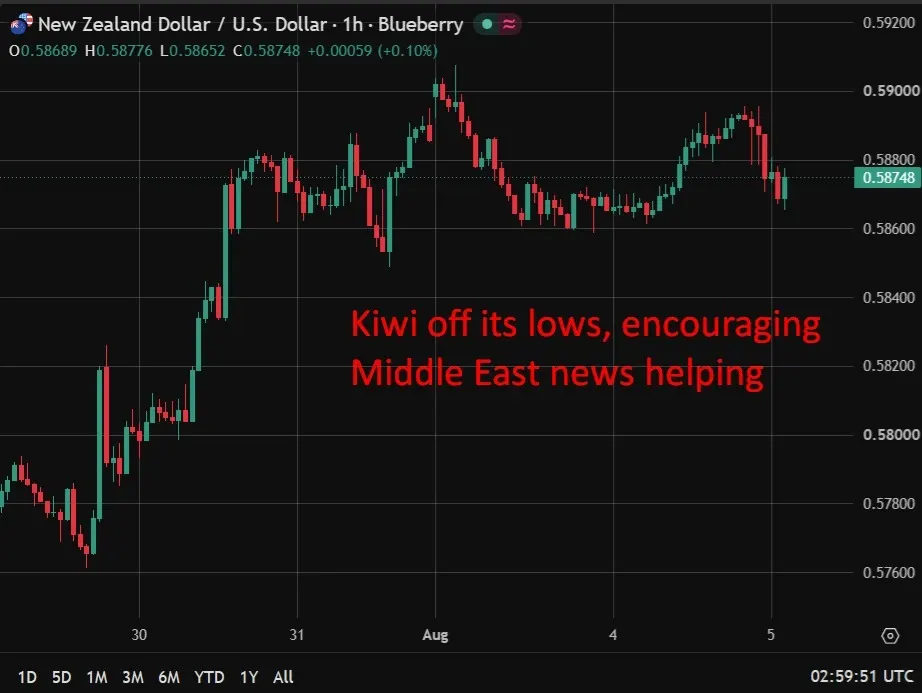
The kiwi dollar reacted negatively to the jobs data, reflecting concerns that the labor market's slack could temper the pace of future monetary tightening, despite ongoing inflationary pressures.
Market impact
This article presents verified public information. Price reaction depends on liquidity and what was already priced in — no directional call is made here.
Institutional framing
TradingBase presents market updates in an institutional financial-news format. This is not investment advice.
Market watch
Track the economic calendar at Economic Calendar, price action at Markets, and signals at Signals.
NIC · Impact scores
Global: 56 · Market: 55 · Urgency: 50 · Confidence: 90 · Neutral
Themes: inflation, rates, energy
Asset impact
- Oil — Neutral (55) · Oil mentioned with balanced cues.
- USD — Bullish (55) · USD leans bullish based on headline/body drivers.
- Commodities — Neutral (55) · Commodities mentioned with balanced cues.
- Forex — Neutral (55) · Forex mentioned with balanced cues.
Market reaction
- USOIL: Price snapshot pending · T-15m / T0 / T+15m / T+60m
- DXY: Price snapshot pending · T-15m / T0 / T+15m / T+60m
- DJP: Price snapshot pending · T-15m / T0 / T+15m / T+60m
- FX: Price snapshot pending · T-15m / T0 / T+15m / T+60m
Trading insight
Analysis only. Not a trade signal. Not investment advice. No Entry/TP/SL is generated by NIC.
Scenarios
- Two-way reaction likely until the market digests the data surprise vs forecast.
- Whipsaw risk is elevated inside the first 15–60 minutes after release.
- For XAUUSD, map USD/rate impulse first, then confirm direction on M15 structure.
Watch factors
- Actual vs forecast surprise (priced-in risk)
- USD / yields impulse if macro-sensitive
- Liquidity and spread during the news window
- Follow-through after T+15m / T+60m
- Relative reaction in oil
- Relative reaction in usd
- Relative reaction in commodities
- Relative reaction in forex
Related events
Related knowledge
New Zealand Unemployment Rate Rises to 5.6%, Highest in 11 Years
Related news correlation
Bank of Japan Minutes Reveal Concerns Over Inflation Risks
Related news correlation
New Zealand Commodity Prices Experience Largest Monthly Decline Since 2022
Related news correlation
Bank of Japan Raises Interest Rate to 1.0% Amid Inflation Concerns
Related news correlation
Japan Real Wages Rise for Sixth Consecutive Month, Bolstering Case for Future BoJ Rate Hikes
Related news correlation
Library
Research depth for related concepts
Ask AI about this article
Answers are grounded in the published article “Kiwi Dollar Weakens as New Zealand Jobless Rate Hits Highest Level Since 2015” and NIC scores — no invented figures.